
AI data centers are much of the talk du jour around the country. That’s certainly true in South Dakota. There isn’t a single town or event I’ve visited where it hasn’t come up at least once.
Folks are worried. They’re worried that their local representatives are at risk of being bought off by data center developers. They’re worried that major decisions regarding large tracts of land and resources in their community are being made in closed-door meetings. They’re worried that mega-corporations will step into their communities, and that they won’t have a say in it.
The people want a voice in this. I’m going to fight to make sure they get one.
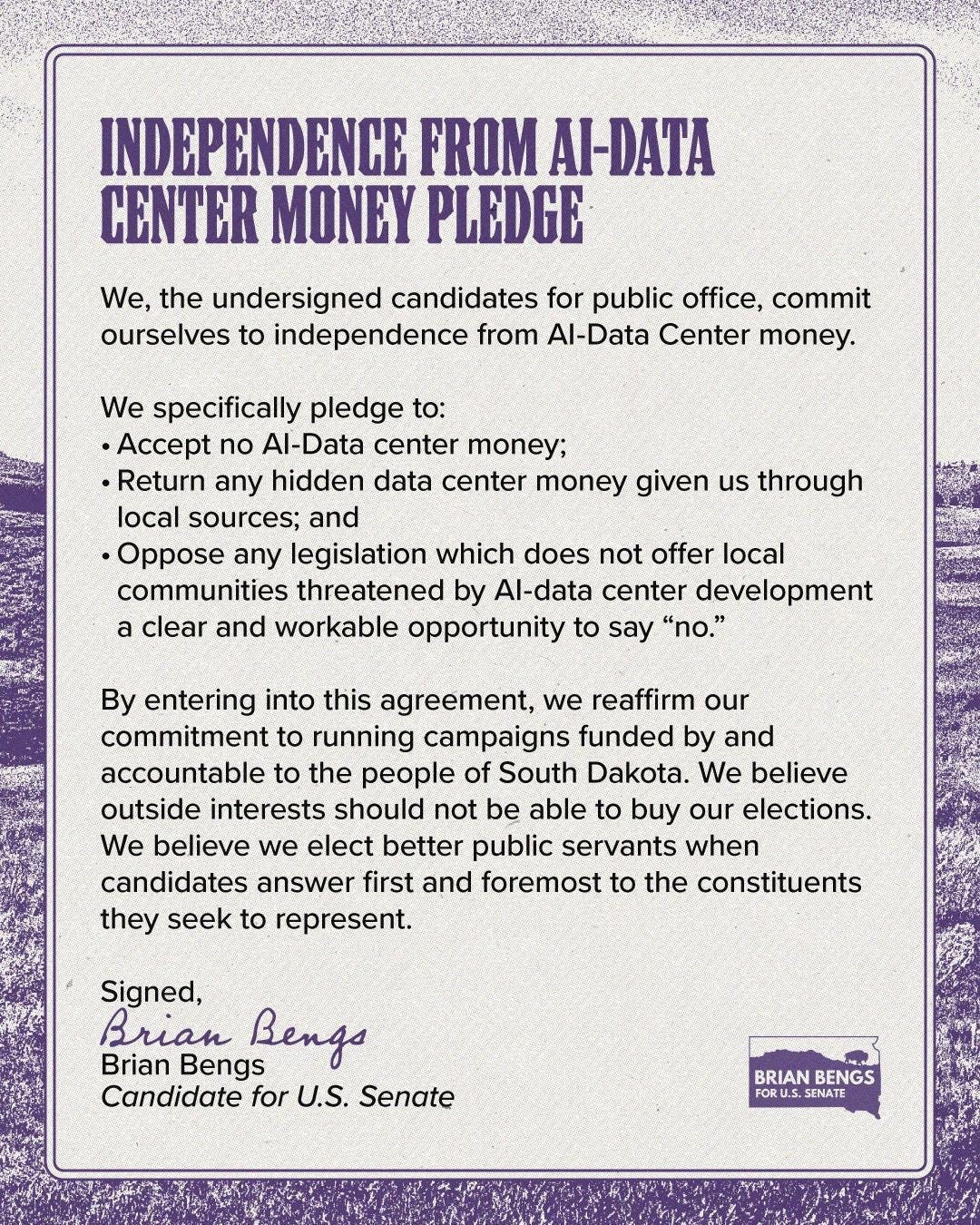
That’s why I’ve officially signed the Independence from AI-Data Center Money Pledge. It’s also why, unlike many data center developers in small communities, I’m giving full transparency on what that means. Here’s what I’ve pledged to:
I will not accept AI-Data Center money.
I will return any hidden data center money given through local sources.
I will oppose any legislation that does not offer local communities a clear and workable opportunity to say “no” to AI-data center development.
I believe in the voice of the people. The whole reason why I’m an Independent is because I value the voices and interests of regular folks above all else.
My opponent won’t ever sign this pledge, because he’s already broken it. He’s accepted hundreds of thousands of dollars from major AI companies in the last year. He’s already bought-and-paid for.
This announcement is sure to ruffle some feathers, especially among my opponent’s Big Money benefactors. If we’re going to stand a chance at showing South Dakotans their options for U.S. Senate before PACs backed by dark money try to flood the airwaves, we’re going to need your help. If 100 people can chip in $40 today, it’ll help us be ready for when the attacks arrive.
My opponent needs to get with the times. At the very least, he needs to take a long hard look at what the people of South Dakota support. Instead, he acts against us at every opportunity.
South Dakota has already passed a “Data Center Bill of Rights.” It prevents regular people from having to shoulder higher electricity bills. It guarantees the right of local governments to regulate AI-data center development, and it requires AI-data centers to be proactive in determining and minimizing the impact of their water consumption on neighboring communities.
The Dot-Com bubble didn’t destroy the internet, but it did have negative consequences that ended up hurting regular folks. I believe AI technology’s development may be very similar, and we need to protect people before the risk gets too high.
AI is probably here to stay, which means data centers are probably here to stay, too. Communities have a right to know how they’ll be impacted, a right to know what data center developers and administrators will do to prevent those impacts, and a right to say “no” if they aren’t satisfied with the answer.
I was a National Park Ranger. I know a thing or two about footpaths and making sure that folks don’t stray too far from them, for the safety and longevity of the ecosystem. AI-data centers are the same. We need to put guardrails up to define where the line is, or else it’s going to be us getting walked over.
Thank you for reading.
Brian L. Bengs, Lt Col (Ret)
Independent Candidate for U.S. Senate
This election is about whether Big Money will continue to have its way with our political system, or if regular folks will take back our voice. Polling shows that we can win this race if we can get my name and message out to South Dakotans, but I need your help to do it. If you can chip in to the campaign today, it will help us keep up the momentum. Thank you.
Keep up the great work Brian Bengs I think you will win. All across the Nation people are raising their voices against data centers we need more politicians like you that will stand up for the people!
For those who want to get up-to-speed on the data center issue, see my Substack. Under the “governing” tab you’ll see several articles on data center issues. The PDF attached to one of them has 400+ articles about data center issues covering activity all across the US.